




















































































































Ferries
Ferries between the islands:
the key information and tips at a glance
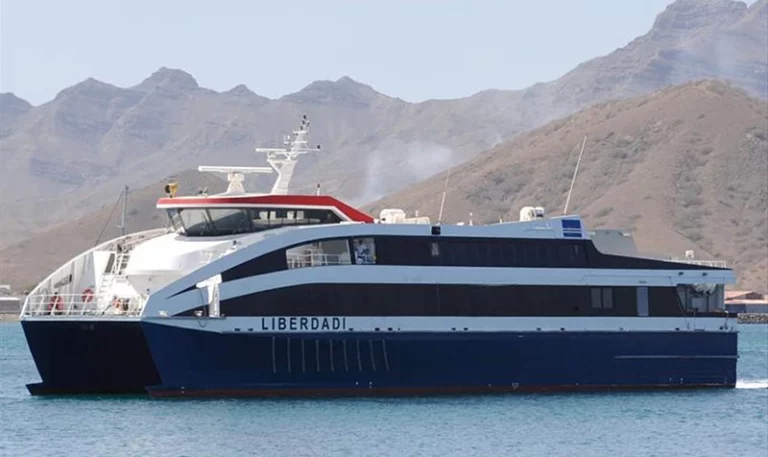
All of the Cape Verde islands are connected by ferry. The main operator is CV Interilhas, which covers the routes with four ferries (two of them fast ferries). The connection to Santo Antão is also served by NosFerry. Alongside these there are smaller operators running individual routes with a single vessel – but usually without a fixed timetable.
Ferries are particularly important for the islands without a (working) airport: Santo Antão and Brava.
Ferry crossing times
Santo Antão is reached by ferry from São Vicente, with a crossing time of around 1 hour. Other relatively short routes work well too, for example Sal – Boa Vista at around 3 hours, São Vicente to São Nicolau at around 4 hours, or Fogo to Brava at about 1 hour.
On many other routes the crossings take considerably longer and you may need to change ferries. From Sal to São Vicente, for instance, you are on board for roughly 10 hours. Longer routes such as São Vicente – Santiago at around 13 hours are best avoided, as they simply take up too much of your holiday.
How reliable are the ferries?
The ferries between São Vicente and Santo Antão are very reliable and run very much on time.
⚠️ The other routes, by contrast, are rather unreliable. If a ferry is cancelled because of technical problems, there is often no replacement. In the worst case, that can mean waiting several days. Weather conditions can also cause crossings to be postponed at short notice or cancelled altogether. Routes served by the fast ferries in particular can be called off when the sea is too rough. The other ferries sail in practically any conditions.
For islands with a working airport, a domestic flight is therefore often the more practical option (see: domestic flights in Cape Verde).
Ferries São Vicente <> Santo Antão
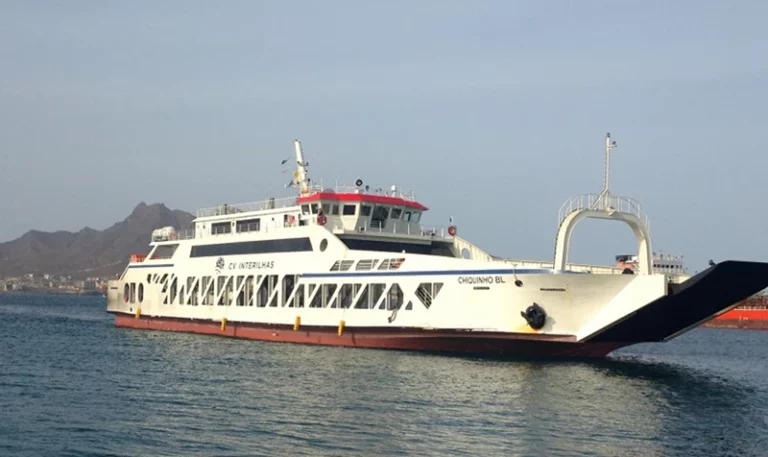
Ferry “Chiquinho”
The CVInterilhas ferry “Chiquinho” runs daily between São Vicente and Santo Antão. The crossing takes 60 minutes. Always arrive 35 minutes before departure – the ferry is extremely punctual and the gangways are pulled away 10 minutes before it leaves.
Tickets are sold in Mindelo right next to the port building, and in Porto Novo inside the port building.
Timetables and online tickets: https://www.cvinterilhas.cv
Mindelo <> Porto Novo, ticket price: 1,511 escudos
⚠️ Please note: there are no sailings on 1 January.
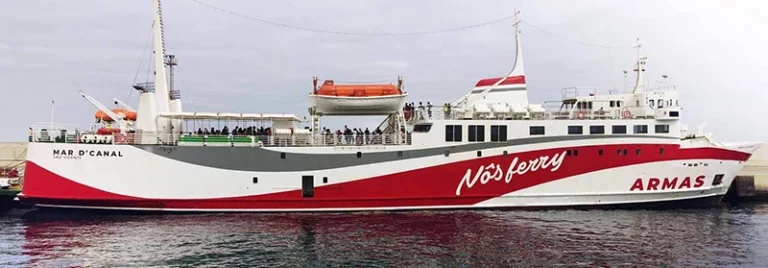
Ferry “Mar d´Canal”
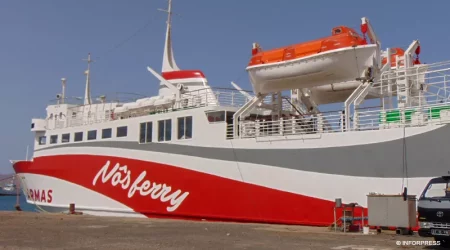
ARMAS – “Nôs Ferry” runs daily between São Vicente and Santo Antão. The crossing takes 60 minutes. Always arrive 35 minutes before departure – the ferry is extremely punctual and the gangways are pulled away 10 minutes before it leaves.
Tickets are sold in Mindelo directly at the port building from 6.00 – 11.00 and 13.00 – 16.00, and in Porto Novo inside the port building from 8.00 – 10.00 and 15.00 – 17.00.
Timetables and online tickets: https://nosferry.cv/
Mindelo <> Porto Novo / ticket price: 1,511 escudos
⚠️ Please note: there are no sailings on 1 January.
Buying ferry tickets online: information and tips
Ferry tickets can be bought through tour operators on the islands or at the ticket desks in the ports. You can also buy online through the websites of CVInterilhas and NosFerry, although you will need a Visa debit or credit card.
Tips for buying ferry tickets online:
• Prices are shown in Cape Verdean escudos, not in euros.
• You can pay with an international debit or credit card.
• If nothing is available, it can help to search for a one-way trip rather than a return.
• You only need to enter the number of tickets for adults, children and infants, plus the names and passport details of the travellers.
• Tickets are usually only available online two to three months ahead, so booking very far in advance is often not possible.
• On some routes it is not possible to book a vehicle space online – in that case you need to buy it at the port ticket desk or through a travel agency.
On board and baggage information
Ferry tickets have to be bought in advance – you cannot buy them when boarding. If you have not booked online, be at the port at least 1 hour before departure to buy them there.
The ferries are gradually being modernised, but in general they are fairly basic, older vessels, apart from the fast ferries, which are somewhat newer.
The air conditioning is often a problem – either it is freezing cold or it is not working and the cabin gets too warm. It is worth packing clothing for both situations.
On board you will find comfortable seats and the chance to buy simple meals, drinks and snacks. On some vessels a particularly luxurious VIP cabin is available for a surcharge. As standard, you may check in two pieces of luggage of 25kg each, plus two pieces of hand luggage of 8kg each. Extra baggage is possible for a surcharge. Checked baggage must be handed in at least half an hour before departure.
Taking a car or hire car on the ferry
Almost all vessels can carry cars. If you have a hire car, check with the rental company beforehand whether taking it on a ferry is permitted. Some companies do allow cars hired on São Vicente to be taken across to Santo Antão. If you are travelling by hire car, it is usually easiest to rent a separate vehicle on each island – and often the cheapest option anyway. Fares for taking a car on the ferry tend to be quite high.
Island hopping by ferry is just one way to see Cape Verde – see all Cape Verde holidays, from beach breaks to round trips and hiking tours.