






















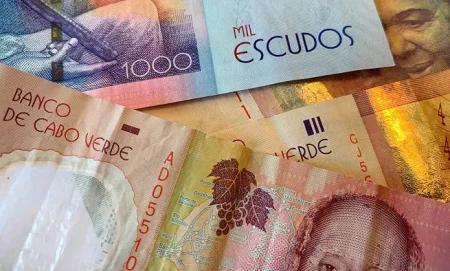















































































The national currency of Cape Verde is the Escudo de Cabo Verde – escudos for short, written as CVE.
The symbol for the Cape Verdean escudo is the dollar sign, $.
It is placed after the amount, so something costing 100 Cape Verdean escudos is shown as 100$.
You will often still see the older notation from the days when escudos had hundredths: 100$00. The final two zeros no longer mean anything today, which is why the dollar sign now sits between the figures. Banks write account balances as 100.00 CVE – here too, the digits after the decimal point are meaningless.
Coins come in denominations from 1 to 100 CVE, notes from 200 to 5,000 CVE.
Every 1,000 escudos is colloquially called a “conto”. A 2,000 escudo note, for example, is “dois contos” – two contos (2 x 1,000 escudos).
Any amount divisible by 1,000 escudos is expressed in contos: one million escudos, for instance, is spoken as “mil contos” (1,000 x 1,000 escudos).
Exchange rate: escudos <> euro
Fixed, non-variable exchange rate:
1 euro = 110.265 CVE, so 100 CVE is about 0.91 euro
The escudo is pegged to the euro, so there are no exchange rate fluctuations.
See: Central Bank of Cape Verde (BCV).
Exchange rate: escudos <> British pound
Variable rate – the escudo follows the euro, not the pound:
1 GBP = approx. 128 CVE, so 1,000 CVE is about £7.80
(Rate checked July 2026.)
Because the escudo is not pegged to the pound, the rate moves with the GBP/EUR rate. In recent years it has stayed in the range of roughly 120 to 132 CVE to the pound.
Sterling is not accepted as payment in shops, taxis or hotels, and only some banks and exchange offices will change it – usually at a poorer rate than euros. Most UK visitors do better bringing euros or withdrawing escudos from a Vinti4 cash machine on arrival.

Exchanging money
There are exchange desks at the four international airports (Sal, Boa Vista, Santiago and São Vicente), but not at the domestic airports.
Otherwise every town has at least one bank, open from 8am to 3pm. There are also exchange offices, which change money at the official rate. In shops and taxis you can sometimes pay in euros, but your change will come back in CVE at a less favourable rate of 1 EUR to 100 CVE rather than the official 110.265 CVE.
Large resorts often offer currency exchange as well.
Outside the towns and airports, the options for changing money are very limited. Never change money on the street.
Credit and debit cards
Credit and debit cards such as Mastercard and Visa are accepted in the main resorts and hotels, at cash machines and in exchange offices, so it is worth bringing one with you. That said, there are also plenty of smaller hotels, restaurants and shops across the islands that do not take cards. It is sensible to always carry some escudos so that you can pay wherever you are.
You will also need a card for the airport security tax (TSA), which every visitor pays on entry if not paid online 5 days before arrival . See our page on the Cape Verde airport security tax.

Paying in euros or US dollars
Euros are accepted in many places in Cape Verde, so if you have some left over you can often pay with them. You will get a poorer rate, though: 1 euro is counted as 100 escudos instead of 110.265, which means you pay around 10% more. Alongside the euro, the US dollar is also widely accepted as a foreign currency, particularly in the larger towns.

Withdrawing cash from ATMs
Every bank has cash machines on its outside wall facing the street. They are marked “Vinti4”.
You can withdraw escudos with a credit or debit card, provided your card is enabled for cash withdrawals abroad. It is worth checking this in your online banking, ideally before you set off on your Cape Verde holiday.
Bear in mind that this can work out more expensive than exchanging euros for escudos in cash, as some banks add 1–3% in fees or apply a less favourable exchange rate.

Tipping
Tipping is customary in tourist areas, particularly in restaurants, bars and hotels. Think of it as a welcome addition to people’s income. A tip of around 10% of the total is much appreciated.
Escudos once you are home
Cape Verdean escudos cannot be exchanged at banks anywhere else in the world, and it is not permitted to take escudos out of the country. In other words, escudos are only used in Cape Verde. Plan to spend what you have before you leave, or change it back into euros while you are still on the islands.

Escudo coins as jewellery
It is not permitted to use Cape Verdean escudo coins to make jewellery. In practice such souvenirs are sometimes sold, but that does not automatically mean you can take them out of the country without trouble. When you fly out of Cape Verde it may be noticed at airport security, particularly if the jewellery is worn visibly. To avoid problems, it is advisable not to wear jewellery made from genuine escudo coins at the airport.
Frequently asked questions
What currency is used in Cape Verde?
The Cape Verdean escudo (CVE). It is pegged to the euro at a fixed rate of 1 euro = 110.265 CVE, so there are no fluctuations against the euro.
Can I pay in euros in Cape Verde?
Often yes, in hotels, shops and taxis. But you will usually be charged at 1 euro = 100 escudos instead of 110.265, so you pay around 10% more, and your change comes back in escudos.
Can I use British pounds in Cape Verde?
No. Sterling is not accepted as payment. Only some banks and exchange offices will change pounds, usually at a poorer rate than euros. Bring euros or withdraw escudos on arrival.
Are there cash machines in Cape Verde?
Yes. Every bank has one on its outside wall, marked “Vinti4”. You can withdraw escudos with a Visa or Mastercard, provided your card is enabled for cash withdrawals abroad.
Can I take Cape Verdean escudos home with me?
No. Taking escudos out of the country is not permitted, and no bank outside Cape Verde will exchange them. Spend what you have or change it back into euros before you fly.